Your Grow Lights Are Secretly Raising Your Electric Bill — Here's the Cheap Fix
Photo: Leonora Enking from West Sussex, England, CC BY-SA 2.0, via Wikimedia Commons
Every December, it happens. You flip on the grow lights, add a second lamp for the shelf in the hallway, maybe drag the fiddle-leaf fig closer to a warmer room — and then your utility bill arrives looking like it took an international flight.
Here's the thing nobody tells you when you fall in love with houseplants: keeping a small jungle alive through a Midwestern or Northeast winter isn't free. But before you start apologizing to your calathea and letting it fade into dormancy, know this — the problem usually isn't the plants. It's how we're lighting and warming them.
Do the Math on Your Glow
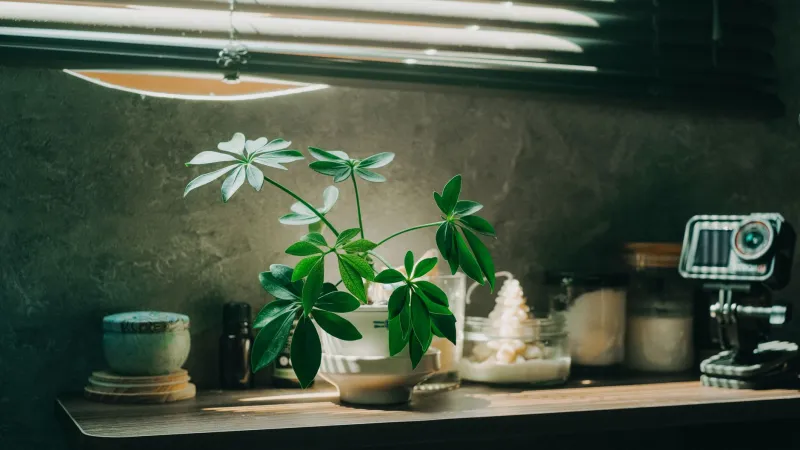
Start with a quick audit. Grab your phone and check the wattage printed on each grow light. A typical full-spectrum LED panel runs 20 to 60 watts. An older fluorescent fixture? Easily double that. Multiply by the hours you leave them on — many of us run lights 12 to 14 hours a day in winter — and suddenly that "little lamp" is pulling real money.
A single 40-watt LED running 14 hours daily costs roughly $2 a month at average US electricity rates. That's fine. Three or four older fixtures, plus a heat mat you forgot about in October, plus the space heater you added because the plants "looked cold"? Now you're in the $30–$50 range, every month, all winter.
The Mirror Trick That Actually Works
Here's the cheapest upgrade in this entire article: reflective surfaces. Most of the light from your grow lamp bounces exactly once — onto the wall behind your plant — and then dies. Paint a piece of foam board white (or use a folded emergency blanket, the shiny kind from the camping aisle) and tuck it behind your plant shelf. You'll redirect 20 to 30% of that light back onto the leaves, which means you can run the lamp for fewer hours or drop to a lower setting.
It's the same principle commercial greenhouses use with reflective wall coverings. Yours just costs about $4.
Stop Heating the Wrong Rooms
Plants don't care about your comfort — they care about consistent temperatures, ideally between 60 and 75°F. If your plant corner sits near a drafty window or an exterior door, you're likely compensating with a space heater, which is the single most expensive way to warm a room.
Instead, relocate. Cluster your tropicals in the room you already heat, away from radiators and vents (that dry air is a separate problem), and let the spare bedroom go cool for the season. Many plants — pothos, philodendron, snake plants — actually tolerate a cooler rest period just fine. You'll save on heating and skip the grow-light guilt for species that barely need it in winter.
Upgrade the Fixtures, Not the Habit
If you're still running clamp lamps with incandescent bulbs or hand-me-down fluorescents, this is your sign. Modern LED grow strips use a fraction of the energy, run cool (less moisture loss from leaves, less watering), and last years. Look for the actual watt draw, not the marketing "equivalent" — a 25-watt LED strip often replaces a 100-watt fluorescent tube.
Two more tweaks that compound:
- Put lights on a timer. A $10 mechanical timer means no more lights burning at 2 p.m. when the sun is already blazing through the window. Twelve hours, on the dot, no thought required.
- Work with the sun first. Before adding artificial light, spend a weekend watching where daylight actually lands in your home. Rotating a few plants into that south-facing window for winter might eliminate one grow lamp entirely — a trick we covered in our sunlight audit, and it pays off double in December.
The Bottom Line
A thriving indoor jungle and a reasonable utility bill aren't enemies. The waste almost always hides in old fixtures, forgotten heat mats, and lights running hours longer than needed. Do the wattage math, bounce light back where it belongs, and let your furnace do the work in rooms you already use.
Your plants will never know the difference. Your bank account absolutely will.